Florida sees more lightning than almost any other state, and Northeast Florida gets its share from afternoon storms all summer. Add the power company switching lines after an outage, and the AC, appliances and electronics in a typical home take a lot of hits.
A whole house surge protector is one of the simplest ways to protect all of it at once. Whether it is worth it for your home comes down to what you own, how old your panel is and what you already have plugged in.
What a Whole House Surge Protector Does
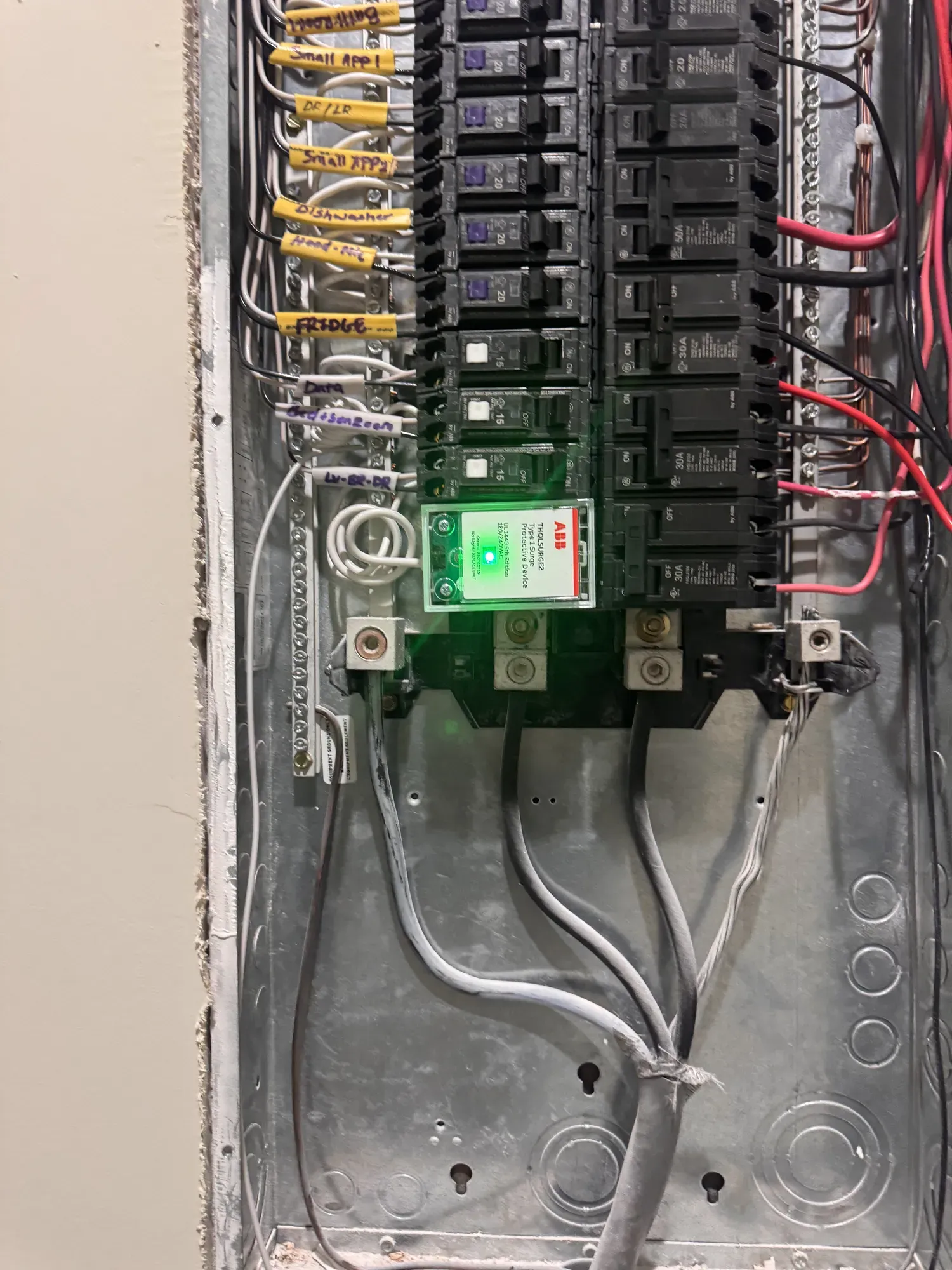
A whole house surge protector, also called a surge protective device, mounts at your electrical panel. When a voltage spike comes in on the utility line, it sends the excess to ground before it spreads through the house.
Because it sits at the panel, it covers the circuits that plug-in strips never reach: the air conditioner, the pool pump, the water heater, the range and the smart thermostat on the wall. On most models a small status light shows that it is working, like the green light at the bottom of this panel.
What It Can’t Stop
No surge protector stops a direct lightning strike on your house. That much energy goes where it wants. What a whole house device handles well are the far more common surges: a strike down the street, a transformer switching, or the jolt when power comes back after a storm.
It also has a working life. Each big surge it absorbs wears it a little. Check the status light now and then. If it goes out, the device has done its job and needs replacing.
Whole House Protection and Plug-In Strips Work Together
A panel device takes the big spikes off the incoming line. A good plug-in surge strip handles the smaller surges that start inside the house, when the AC compressor or a motor cycles on and off.
For most homes the best setup is both. The panel device protects everything, and point-of-use strips add a second layer for the TV, the computer and other sensitive electronics.
When Is It Worth It?
For most homes in St. Augustine, Ponte Vedra Beach and Nocatee, the answer is yes. It is especially worth it if any of these fit your home:
- You have newer, electronics-heavy appliances. Variable-speed AC systems, induction ranges and smart appliances all have circuit boards that surges damage.
- You have a pool, a well pump or a generator. Motors and outdoor equipment take hits from storms.
- You live near the coast or on a long overhead line. Exposed lines pick up more surges.
- You are replacing your panel. Newer editions of the National Electrical Code call for surge protection when a home’s main panel is replaced, so it is usually part of the job anyway.
How the Install Works
The device mounts in or right next to your main panel and connects to its own breaker. For most homes it is done in a single visit, and we test it before we leave.
If your panel is old, full or one that insurers flag, it makes sense to look at the whole picture. A panel upgrade and the surge device can be done in one visit. Our whole house surge protection page covers the details, and our post on backup power and surge protection in Florida explains how a generator fits with it.
Want to know if your panel has room for one? Ask for a free quote and we will take a look.
Need help with this? See our whole house surge protection or call (904) 837-0310.